Simple steps that change how work feels and performs
If you’ve ever walked into a workspace and instantly felt the difference. Clear walkways, tools exactly where you expect them, equipment that just works, you’ve probably experienced the impact of 5S. It’s one of the simplest Lean tools, but also one of the most powerful. The 5S system is built around five Japanese words that describe the stages of workplace organisation. 5S is a systematic approach to workplace organisation and housekeeping, encouraging ownership and self‑discipline to sustain and further develop working practices. Despite its reputation, 5S is far more than a tidy‑up exercise. It’s a foundation for safer, smoother, and more predictable work.
What 5S Really Means
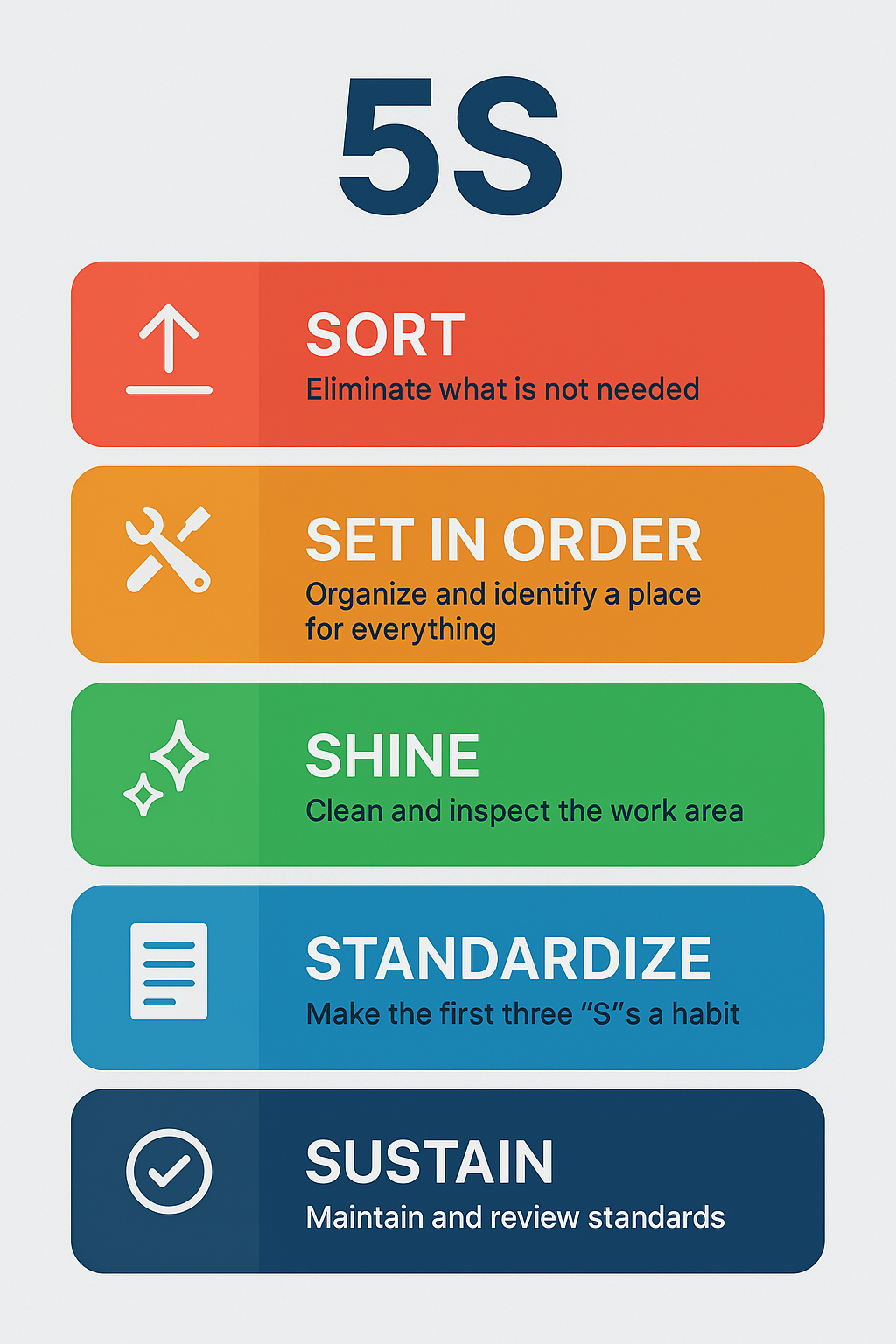
5S turns a messy, unpredictable area into a place that’s safe, fast, and easy to work in. The five steps are action‑focused and easy to explain to any team:
- Sort — Remove anything not needed for the work. This reduces clutter and makes problems easier to spot.
- Set in Order — Give everything a logical home so it’s easy to find, use, and return.
- Shine — Clean with purpose: not to polish, but to detect leaks, wear, or abnormalities early.
- Standardise — Create simple, consistent ways of working through checklists, visual controls, and routines.
- Sustain — Build the discipline and habits that keep 5S alive every day.
Many teams add a sixth S — Safety — because good organisation naturally reduces slips, trips, spills, and confusion.
More Than Housekeeping
Organising the workplace properly, not just having a tidy‑up… removing all types of waste, not only scrap or rubbish. 5S helps teams understand and eliminate the seven wastes of Lean – Transport, Inventory, Motion, Waiting, Overproduction, Over‑processing, and Defects – plus the often‑forgotten waste of unused talent. By making waste visible, 5S becomes a gateway to continuous improvement.
Why 5S Matters for the business
A well‑organised workplace supports:
- Reduces mistakes — cleaning and checks find problems early.
- Improves safety — Clear walkways and labelled storage reduce accidents.
- Saves time — Less time searching means more time doing value‑adding work
- Lowers costs — Fewer defects, less downtime, and smoother flow all reduce operating costs.
- Makes work smoother — consistent layouts and routines mean fewer interruptions.
- Quality – Early detection of wear, leaks, or damage prevents defects.
These outcomes add up: better uptime, fewer accidents, reduced inventory, and more predictable output — the building blocks of reliable performance.
Why it matters for people
5S isn’t just about equipment and floors; it changes daily experience:
- Less stress — You spend time doing work, not looking for things.
- More pride — Teams who keep their area tidy feel ownership and satisfaction.
- Clear expectations — Visual standards remove guesswork about what “good” looks like.
- Opportunity to improve — Small ideas from the team make daily work easier and more efficient.
When staff see quick wins from simple changes, engagement rises and continuous improvement becomes part of the job.
How 5S becomes effective
- Start small and visible — pick one area with frequent problems (tool bench, packing table, changeover station).
- Run a focused Sort event — remove or tag unnecessary items; decide what stays.
- Set in Order with visuals — labelled storage, shadow boards, and photos of the standard.
- Shine to inspect — cleaning becomes inspection; log and act on abnormalities.
- Standardise simply — one‑page checklists and a photo of the correct setup.
- Sustain with short daily checks — 5–10 minutes at shift start or end; rotate ownership.
- Audit with coaching — audits should help teams improve, not punish them.
- Link 5S to real problems — tie activities to measurable goals (reduce search time, cut changeover minutes).
Avoid big‑bang rollouts. Phased, visible wins keep momentum and show value quickly.
Why 5S Fails (and How to Avoid It)
Even the best 5S efforts can fade if the foundations aren’t right. Common pitfalls include:
- No ownership → assign daily owners and area owners.
- No standards → post simple visual standards so everyone knows what to aim for.
- Leaders don’t reinforce → managers must participate and allocate time.
- Cleaning without problem‑solving → use Shine to find and fix root causes.
- No follow‑up → schedule short audits and improvement cycles.
- Trying to change everything at once → focus on one pilot area and scale.
Clarity, leadership support, and coaching audits prevent most failures.
Roles That Make 5S Work
Sustaining 5S is a team effort:
- Operators — maintain daily 5S and spot abnormalities.
- Team Leaders — coach, run checks, and remove barriers.
- Area Owners — approve changes and own the area condition.
- 5S / CI Champions — train, support, and lead audits.
- Managers — set expectations and reinforce behaviours.
- Auditors — give constructive, improvement‑focused feedback.
When everyone plays their part, 5S becomes a natural way of working — not an extra task.
A Foundation for Continuous Improvement
5S is often the first Lean tool introduced because it creates the conditions for everything else: standard work, visual management, problem‑solving, and stable processes. Towards the end on this newsletter, our presentation module highlights real‑world gains such as “faster changeovers, fewer accidents, reduced inventory, better equipment uptime, and more predictable output.”
These aren’t small wins—they’re the building blocks of world‑class performance.
Bringing It All Together
5S isn’t a project or an event. It’s a habit. A culture. A shared commitment to making work easier, safer, and more effective. As the training module concludes, “When we all take ownership, 5S becomes part of how we work — not an extra task, but a better way of doing our jobs.”
If your workplace wants to improve flow, reduce waste, or simply make daily work feel smoother, 5S is the place to start.
 What-News
Leave a comment